
Someone asks a question. There’s a pause. Then another. The person asking repeats it, rephrases it, or fills the gap with “Did you hear me?” Meanwhile the answer was on its way, and now it has to start again.
For many autistic people, a pause in conversation isn’t rudeness, confusion or disinterest. It’s processing time: the time it takes to take in what was said, work out what’s being asked, and put a reply together.

What’s happening in the pause
A spoken conversation asks for a lot at once. The words themselves, the tone, the facial expression, eye contact, when to speak, and what the other person might really mean. Many autistic people describe handling those layers one at a time, rather than automatically, which takes longer.
In a 2025 study of autistic adults’ own accounts of communication, people described nonverbal cues as taking extra time and effort to read, and keeping track of eye contact, gestures and speech at the same time as “just too much going on”. The authors suggested allowing extra time for responses and avoiding interruptions (PLOS One, 2025).
Why rushing makes it slower
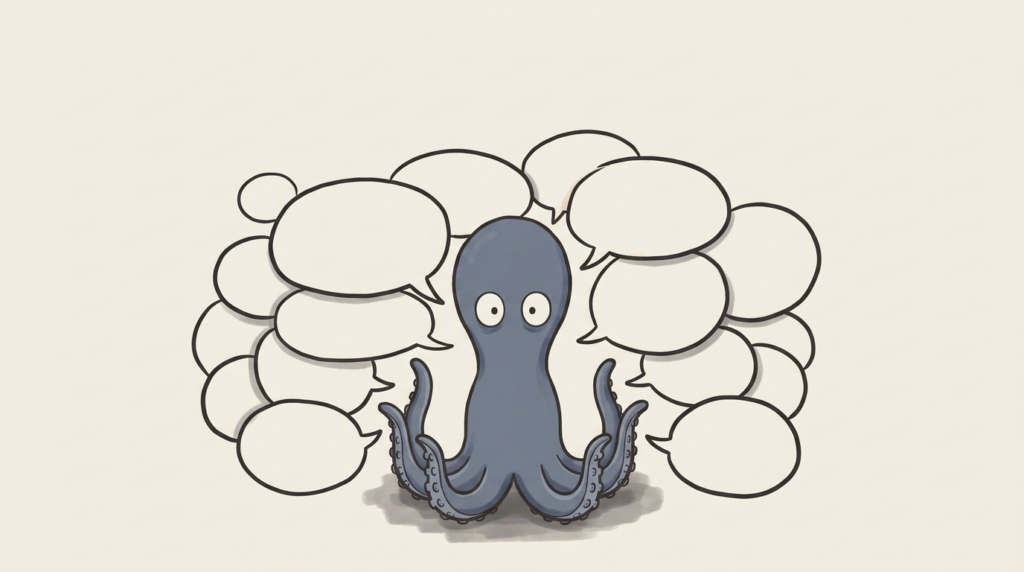
Repeating the question, rewording it or adding a new one in the gap can feel helpful. For someone who is processing, it often does the opposite: it adds new input and resets the work already done. The reply arrives later, or not at all.
- Silence can mean “still thinking”. It doesn’t always mean “didn’t hear” or “doesn’t know”.
- Repeating restarts the clock. A new version of the question is a new thing to process.
- Pressure narrows thinking. Feeling watched while answering tends to make words harder to find.
Small changes that help
- A longer wait. Counting to ten silently after a question gives the answer room to arrive.
- One question at a time. Two questions in one sentence doubles the processing.
- The same words if repeating. If a question needs repeating, the same wording is easier than a new version.
- A written option. Questions sent ahead, or a chance to reply by message afterwards, take the time pressure away.
- “Can I come back to you on that?” A normal, accepted phrase that buys time without awkwardness.
At work and in meetings
Meetings are often where processing time gets squeezed the most: fast back-and-forth, interruptions and on-the-spot questions. Agendas sent in advance, a chat channel for comments, and a chance to add thoughts after the meeting help autistic colleagues contribute fully, and they help many others too.
In Australia, changes like these are often called reasonable adjustments. Time to answer, written questions and agendas ahead of time are usually simple and low-cost to offer.

Where Digital Cortex fits in
Digital Cortex gives thoughts a calm place to land after the conversation is over. Notes and follow-ups can go straight into Tasks, so “I’ll come back to you on that” turns into a reply that actually gets sent. For calls that feel like a lot, our post on phone call scripts for autistic adults covers simple scripts that take some of the pressure off. More on how we design for autistic minds is on our autism page.
Silence is part of the conversation
A pause before an answer is often a sign that someone is taking the question seriously. Leaving that pause alone, without filling it, is one of the simplest ways to make a conversation easier for an autistic person.
FAQ
Why do autistic people take longer to answer questions?
Many autistic people process spoken language, tone and body language one layer at a time rather than automatically. Putting a reply together can take longer, especially under pressure or when several things are happening at once.
Is a long pause in conversation rude?
Not necessarily. For many autistic people, a pause means the answer is still being worked out. Waiting quietly usually helps more than repeating or rewording the question.
What is processing time?
Processing time is the time it takes to take in information, make sense of it and respond. It varies from person to person and often grows when someone is tired, stressed or overloaded.
Sources
- “There is just too much going on there”: Nonverbal communication experiences of autistic adults (2025). PLOS One. doi.org/10.1371/journal.pone.0325465
This article is for general wellbeing information and isn’t medical advice. For questions about autism, speak with a GP or psychologist.


